
Conservation of Veda Temple Baradari
From structural collapse to stabilised heritage — a complete conservation of a 200-year-old Baradari using traditional lime, Thapi craftsmanship and modern engineering.

28+
Mechanical jacks deployed
11"
Dead mortar removed
4
Restoration phases
200+
Years of history saved
Initial condition — a structure in critical distress


Materials Used — Conservation of Veda Temple Baradari
A high-durability traditional mortar mix — no cement, no shortcuts. Six natural ingredients, perfected over centuries of Rajasthani building craft.
-
Traditional organic additives — integrated into the lime to enhance carbonation speed and long-term water resistance of the final surface.
-
The primary base of the entire mortar system. Traditional pit-slaked lime — allows the plaster to breathe, move and self-heal micro-cracks as it ages over decades.
-
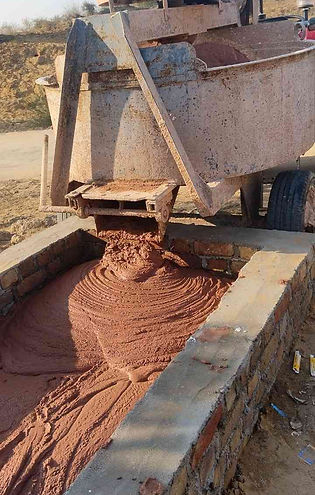
Crushed terracotta brick fragments that create a pozzolanic reaction with lime — significantly increasing the strength and durability of the mortar, especially in waterproofing applications on roofs.
-
Dry grass fiber woven through the mortar matrix acts as natural reinforcement — preventing shrinkage cracks during the drying process and adding tensile strength to an otherwise rigid plaster.
-
Local sandy soil providing the bulk filler of the mortar body. Locally sourced material ensures chemical compatibility with the original 1800s masonry — reducing risk of future incompatibility damage.
-
Finely ground brick powder (surkhi) creates the smoothest surface layer. Used in the final Thapi coat — its fine particle size allows burnishing to the hard, water-resistant Lime Singla finish.


Phase I — Emergency Stabilisation

28 jacks. One mission — stop the collapse.
Before any demolition or repair, 28 mechanical jacks were deployed to transfer the roof's weight and stabilise the structure. Tilting was monitored and a buttress support installed.
Phase II — Deconstruction and Material Removal
Where tradition meets engineering
New steel Gutoo girders were installed with 3-coat enamel anti-rust treatment. A cotton buffer layer was placed between steel and lime to prevent chemical reaction. Cracks were stitched layer by layer in in-situ material.


Brick reconstruction of collapsed arched wall sections
Shows workers on scaffolding reconstructing the arched wall in brick — rebuilding collapsed sections before lime plastering. Label: "Brick reconstruction of collapsed arched wall sections."

Systematic stripping — dead lime mortar removed
Shows the stripping process — dead, rusted mortar being removed to reveal the original stone and lime fabric beneat

Original stone and masonry substrate revealed
Shows the original 1800s stone and brick substrate after all the dead plaster and mortar has been stripped away — the authentic fabric beneath.
Phase III — Structural Stitching and Reinforcement

Where tradition meets engineering
New steel Gutoo girders were installed with 3-coat enamel anti-rust treatment. A cotton buffer layer was placed between steel and lime to prevent chemical reaction. Cracks were stitched layer by layer in in-situ material.
Phase IV — The Lime Cycle and Thapi Finishing
The Thapi Technique — 5-step lime mastery
1
Lime pit
Khor, lime and brick zeera mixed
2
Core layer
Substrate levelling mortar
3
Thapi
7–9 days hand-beating per layer
4
Burnish
Lime Singla — polished finish
5
Film coat
2–3mm protective lime on roof


The transformation — the Veda Temple Baradari


Before: roof in critical condition
After: completed lime roof

